
Hajj: When Discipline Becomes the Path to Inner Freedom
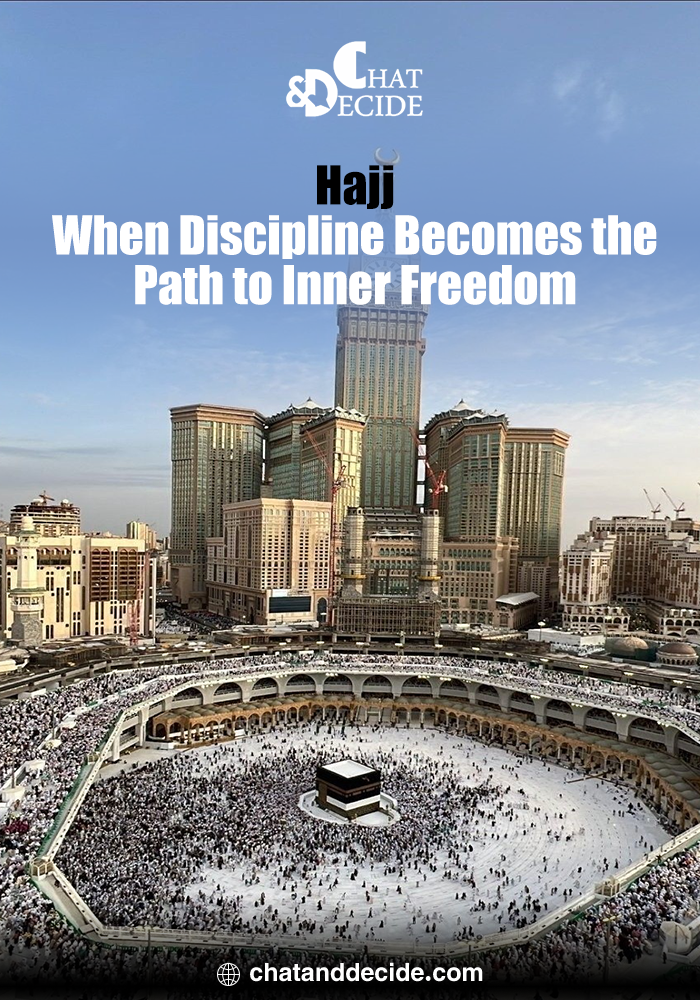
Hajj: When Discipline Becomes the Path to Inner Freedom
In a world increasingly defined by indulgence and personal chaos, one is struck by a scene that seems to defy modern norms:
Millions of people, from every age and culture, adhering to a precise and unified order, without room for personal timing or flexible interpretation.
This is Hajj.
In Hajj, one does not move at their own pace or according to personal comfort—but in accordance with a Divine command.
– Each ritual has a set time,
– Each step has a fixed sequence that cannot be advanced or delayed,
– One endures crowds, heat, and fatigue,
– And maintains discipline, not only in actions, but in words, thoughts, and even the smallest reactions.
But the greater question is: Why?
Because Hajj is not merely a set of rituals, it is a living school that trains the soul in obedience, discipline, and surrender to God.
In Hajj, the believer learns to say to God, with full awareness:
“I will not do what I desire, but what You have commanded.”
“I will circle when You ask me to, I will stand where You command, and I will be patient when You test me.”
This discipline is not mechanical, it is spiritual refinement.
It tames desire, strengthens the will, and becomes a hands-on lesson in self-mastery for the sake of a higher purpose.
And here lies the beautiful paradox:
The more the pilgrim submits to divine order, the freer he becomes.
Free from distraction, ego, and the grip of unchecked desires.
In Hajj, submission is not weakness—it is the pinnacle of strength. Discipline is not confinement, it is the gateway to true liberation.
It is a rare harmony: a disciplined body, a liberated soul, and a heart at peace.
And that is why the pilgrim returns transformed, no longer the same person who first departed.